
Results-Base Accountability Training
What is Results-Based Accountability?
The Results-Based Accountability (RBA) framework connects local data related to a community issue to drive work toward a common population result. This is followed by a set of goals and activities that will create the desired impact on the focused trendline, which projects how data trends will continue without intervention. Results-Based Accountability begins with the end results groups want in their communities and works backwards toward the how the change can be accomplished.
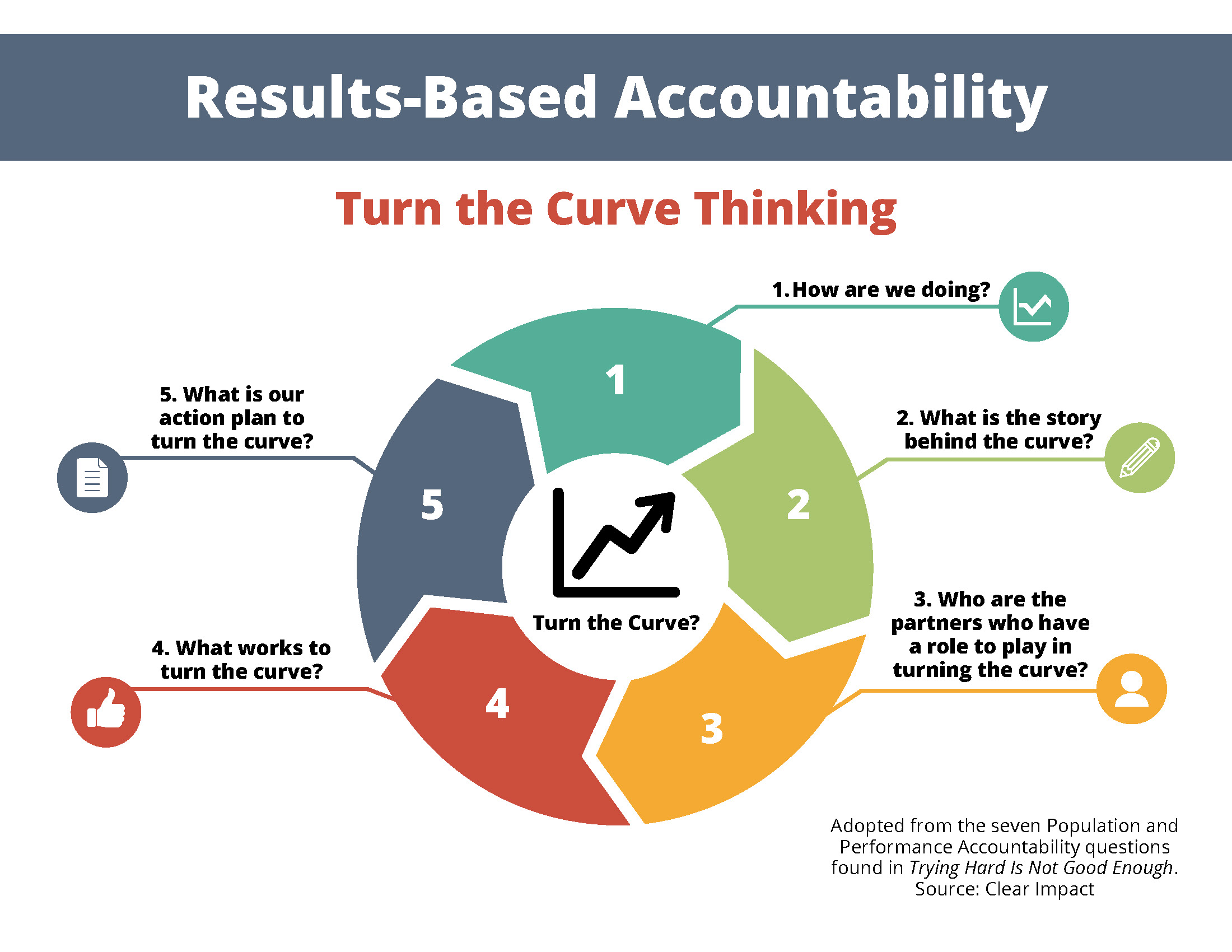
Results-Based Accountability utilizes 'Turn the Curve Thinking' to guide planning activities, which involves using five questions to create an action plan. Each step has corresponding processes which moves planning activities forward. These processes allow for participants to rank ideas to find solutions which are tailored to the community context and planning groups.
Turn the Curve Thinking can be used to address community issues or to identify ways to improve programming which provide direct services to child, youth, families, and seniors across each sector of the community.
Here's an overview of Turn the Curve Thinking:
Local RBA Training
The Boone County Community Services Department received funding from Missouri Foundation for Health to host community trainings on RBA. With their support, the department trained over 120 individuals representing more than 50 organizations and institutions through four training cohorts and three learning labs.
The trainings equipped nonprofit leaders, government officials, and community members with a common language and framework to strengthen collective impact. Multiple collaborative efforts continue to integrate the RBA framework into their design and implementation, including the Boone County Upward Mobility initiative.